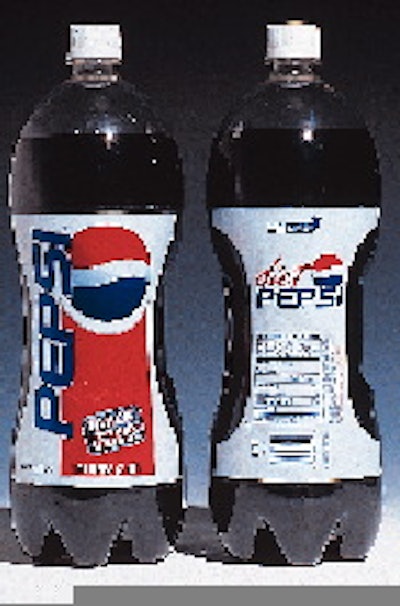
Though consumers with small hands are the obvious target for the indented, easy-to-grip bottle, Pepsi is aiming it at everybody with its in-store promotional tag-line of "Everybody's getting a grip." The bottle was invented and patented by Emery Valyi, who has assigned exclusive rights to Pepsi. Schmalbach-Lubeca (Manchester, MI) produces the bottle, which carries a heat-transfer label on front and back. The Quick Grip bottles in the Detroit test hold 1.9 L of Pepsi, Diet Pepsi or the caffeine-free versions of both. But Jabbonsky says that bottles for a rollout, should the current test prove successful, would carry a full 2 L. Hand grips are found in large bottles for liquor and juices. But these products are not carbonated the way Pepsi is. The technical challenge in designing the Quick Grip was to prevent the indentations from being forced out to the bottle's circumference by the internal pressure caused by carbonation. To overcome this, Valyi designed an injection mold core having a slot cut into its center. When molten resin flows between core and cavity, it also flows into the slot, creating a preform having an internal wall down the middle. When the preform enters the blow mold, a v-shaped register notch formed in the neck ring is used to mechanically orient the preform so that its internal wall faces correctly. During blowing, the wall remains attached to the sidewalls at the grip area. The end result is a bottle standing about 12" tall with a 7" wall in the middle. While a standard PET 2-L bottle weighs about 49 g, this bottle, weighed in Packaging World's office, came to 62 g. Valyi predicts the bottle may get down to 55 g when full-scale production is achieved. Pepsi's strategy, presumably, is to absorb any upcharge if it results in a uniquely differentiated package that will increase market share. According to Jabbonsky, it's too early to pinpoint what the bottle will cost, though the Detroit test should provide some clues. But regardless of how the cost-per-bottle question shakes out, "The consumer will not bear any additional expense," says Jabbonsky.