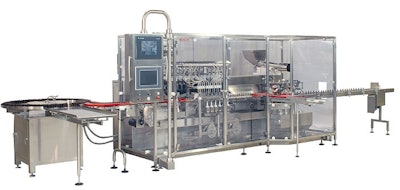
Scheduled for a May 2004 startup at Bio-Rad is a Model FLM 4120 high-speed filling/stoppering machine from Bosch Packaging that’s rated at 450 vials/min. It’s enclosed in a cabinet where HEPA-filtered positive air flow keeps contamination at a Class 100 level.
The FLM 4120 is a continuous-motion linear system with 12 filling nozzles that stroke forward and back so they can fill vials on the move.
The FLM 4120 is Bosch Packaging’s first vial-filling system built from the ground up around servo motors. A total of 24 Elau servo motors execute the commands issued by an Elau motion controller, which in turn is governed by the filler’s Allen-Bradley Contrologix PLC from Rockwell Automation. In addition to controlling vial transport, stoppering, and infeed/outfeed starwheels, a servo motor controls each filling valve.
“The servos mean we can adjust the pump stroke electronically rather than mechanically,” says Bio-Rad engineer John Augsburger. “It’s faster and it’s more accurate.”
Checkweighing is what determines if a change in pump stroke is needed, and the Bosch system is a bit out of the ordinary in how it goes about checkweighing. In many vial-filling systems, a robot pulls one vial out so a scale can weigh the empty vial. The robot then returns the vial for filling and a second robot pulls that filled vial out to weigh it. By subtracting empty-vial weight from filled-vial weight, the exact weight of the product in the container is determined.
The Bosch Packaging system also compares empty-vial weight with filled-vial weight. But it doesn’t do it one container at a time. Instead, a robotic device picks and places 12 empty vials on load cells parallel to the flow of vials that pass through the filler. After gathering tare weight data on each of 12 vials, the robot returns them to the flow of vials for filling, and then it goes back and gets them to weigh each vial again. After this second weighment, the filled vials are returned to the main flow for stoppering.
All the weights recorded by the load cells are tracked by the PLC, and all this data is crunched by statistical analysis software. If vials are trending outside preset limits, dosing will be adjusted automatically. “The system will make adjustments on the fly based upon a statistically significant event,” says Augsberger.
See the story that goes with this sidebar: Vial packaging extraordinaire