Deoleo, a global olive oil producer operating in 70 countries, is advancing circular packaging by achieving 79.2% recyclable SKUs and 40% recycled PET content while maintaining product protection through innovations like blue glass bottles, mono-material designs, and blockchain-enabled traceability.
- Recyclability Progress: Deoleo achieved 79.2% recyclable SKUs in 2025, exceeding its 75% goal and targeting 100% compliance with EU recyclability standards by 2030.
- Plastic Reduction: The company reduced primary plastic use by 11.4% compared to a 2020 baseline, surpassing its 7.5% 2025 target with a 15% reduction goal for 2030.
- Blue Glass Innovation: Deoleo introduced blue glass bottles for Carapelli brand in Italy after research showed blue glass provides better light protection than traditional green glass, preserving chlorophyll and reducing oxidation.
- Recycled Content Achievement: Deoleo reached 40% recycled PET (rPET) in PET packaging by 2025, five years ahead of its original 2030 target, with plans to expand to seed oils and other product lines.
- Digital Traceability: Unique QR codes on packaging use blockchain technology to connect consumers with product origin, sourcing details, and sustainability information tied to individual bottles.
Global olive oil producer Deoleo is working to make its packaging more sustainable while preserving the quality of the product inside. That constraint is common across food packaging, but it is especially critical for olive oil, which can be affected by light, heat, and time. Any change in material, structure, or weight still has to protect the oil throughout its shelf life.
That requirement shapes packaging development across a company that sells its products in roughly 70 countries and has around 650 employees. Deoleo’s portfolio includes nearly 30 brands across olive oil, olives, sauces, and vinegars. In the U.S., its primary brands are Bertolli and Carapelli, with Spanish brand Carbonell also sold to Latin communities in Miami and South Florida.
Jose Bonache Aparisi, global corporate communications director for Deoleo, describes the company’s broader sustainability strategy around three pillars. Growing Together focuses on working with farmers and mills on environmental, social, and agricultural practices. Blending With Love centers on maintaining the quality of the olive oil and developing blends for different markets and consumers. Caring for You includes consumer education around olive oil and the Mediterranean diet. A responsible-business component addresses how Deoleo carries out the strategy and embeds ESG practices throughout the company.
Those sustainability priorities carry into packaging development, where circular-economy criteria guide decisions on new formats and materials.
A circular-economy filter for packaging
Deoleo evaluates new packaging through a circular-economy framework that begins at the earliest stages of development. According to Daniele Pucci, global R&D packaging manager at Deoleo, the team looks at whether a package can be collected, sorted, and recycled in the market where it will be sold. It also considers material reduction, recycled content, opportunities to simplify structures through mono-material design, and protection of the product throughout its lifecycle.
Those considerations can work against one another. A structure that uses less material, for example, still has to provide the necessary strength and barrier properties. Recycled material has to meet quality and food-safety requirements. A package designed for recycling also has to work within the collection and processing infrastructure available in a particular country.
“The R&D job can be quite complex because we always have to find the right balance among sustainability, functionality, consumer experience, and food protection,” explains Pucci.
To evaluate those tradeoffs, Deoleo uses equipment in its own plants along with external laboratories and experts to conduct migration analysis, performance testing, and mechanical stress testing on new materials and package designs.
Deoleo’s 2025 sustainability results provide a measure of its progress toward its circular economy goals. The company reports that 79.2% of its SKUs are now recyclable, up from a 70% baseline in 2023 and ahead of its 75% goal for 2025. Its current target is for 100% of its packaged SKUs to meet EU recyclability standards by 2030. Deoleo also reports a cumulative 11.4% reduction in its use of primary plastic compared with a 2020 baseline, exceeding its 7.5% goal for 2025. Its 2030 target calls for a 15% reduction.
Blue glass challenges a familiar category cue
One recent packaging project addresses sustainability by focusing on product protection. Deoleo recently collaborated with the University of Perugia in Italy to study how light affects olive oil and how different bottle colors protect the product.
 Deoleo introduced Carapelli’s blue-glass bottle after research with the University of Perugia found the color offered greater protection from light than traditional green glass.Deoleo
The research led the company to introduce a blue glass bottle for its Carapelli brand in Italy last year. According to Deoleo, the study found that blue glass provided better protection from light than the darker green glass traditionally associated with olive oil.
“Chlorophyll absorbs the blue wavelength. If you use blue glass, the chlorophyll can be preserved, and there is less oxidation in the extra virgin olive oil,” Pucci explains.
Changing from green to blue glass, however, means Deoleo must educate consumers. Olive oil is a visually traditional category, and green and dark-colored bottles are familiar signals on the shelf. “When you’re in a supermarket in Italy or France and you see this blue bottle for the first time, it’s surprising because it’s something new,” says Aparisi. “So we need to explain to consumers why it’s blue.”
Deoleo is starting with Carapelli and watching consumer reaction, with the possibility of eventually extending the blue bottle to other brands.
Mono-material work targets difficult formats
Deoleo’s transition from multi-material to mono-material packaging is still underway, with closures, spray containers, and flexible packages among the formats receiving particular attention. But simplifying a package for recycling can be difficult when each layer or component performs a specific function.
“With all of these multi-material, multi-component packaging designs, product protection is critical,” says Pucci. “It’s a must-have.”
Closures offer one opportunity for material simplification. Some PET bottles use a high-density polyethylene cap with a low-density polyethylene pourer, while others combine polypropylene and LDPE. Deoleo is studying prototype single-piece, mono-material closures, taking cues from the integrated design approach used in Tetra Pak caps to reduce the number of materials and components in the closure.
Spray packaging is another area Deoleo is trying to simplify. Some of the company’s spray packages currently combine an aluminum outer container with an internal multilayer, multi-component pouch. Deoleo is evaluating alternatives that would pair a PET container with a mono-material plastic pouch to simplify the structure and make it more compatible with existing recycling streams.
Flexible formats are another focus. Sachets, doypacks, and spouted bags in Deoleo’s portfolio currently rely on multilayer structures to provide the necessary product protection.
Both formats remain among the technically challenging SKUs Deoleo still needs to address as it works toward its 100% recyclability goal. For now, the existing structures continue to serve an important functional role.
“Today’s single-component plastic alternatives cannot provide the same barrier performance,” Pucci says. “We are confident optimization will be achieved in the future, but we are not at that point yet, so we have to keep working on it.”
Designing across markets adds another layer
A package developed for a global portfolio also has to contend with recycling infrastructure and regulatory requirements that vary by market. Deoleo’s regulatory department works with R&D, procurement, marketing, and commercial teams, along with industry associations and outside experts, to track those requirements.
Pucci cites California’s SB 343 along with Europe’s Packaging and Packaging Waste Regulation, EPR requirements, and EU recyclability criteria among the issues Deoleo is following. “Our process is to map all the requirements, and our goal is to develop the most globally compliant packaging solution possible,” he says. “However, we are fully aware that some local requirements cannot always be fully harmonized.”
When necessary, Deoleo will create additional packaging variants to meet individual market requirements. Pucci says that comes after the company first tries to reduce complexity and develop a structure that can work across as many markets as possible.
But Deoleo’s approach extends beyond meeting current market requirements. “We always want to go one step ahead,” Aparisi says. “Regulation is the minimum for us.”
rPET reaches its 2030 goal early
Recycled PET represents one of Deoleo’s more advanced circular-packaging initiatives. In 2025, the company reached 40% rPET in its PET packaging, achieving a goal originally set for 2030. The company is progressively extending the use of rPET to other product lines, including seed oils. How quickly that expansion can happen depends partly on the availability of food-grade PCR resin in individual markets. Resin quality and the recycling technology used to produce it affect package performance as well. Cost adds another variable.
In 2025, Deoleo reported that the additional operating cost of using rPET rather than virgin PET exceeded €925,000 (nearly US$1 million). Pucci says market conditions changed in 2026, with the price gap between recycled and virgin PET narrowing or, in some cases, partly reversing as crude oil, energy, and transportation costs affected virgin resin prices.
Even when the economics work, rPET requires additional technical evaluation. Deoleo repeats barrier-performance and migration testing on recycled PET rather than relying on results from the virgin material. Appearance can also present a hurdle. “Recycled PET can have a natural grayish tint or darker tone that is not always well received by consumers, who expect greater transparency, especially in seed-oil products,” Pucci says.
Deoleo views the use of recycled material through a longer-term business lens that includes its environmental targets, regulatory requirements, consumer expectations, and supply-chain flexibility. Increasing recycled content can also reduce dependence on virgin feedstock.
QR codes add a digital layer of traceability
Beyond its work to increase recycled content, Deoleo is also using the package as a way to give consumers greater visibility into the product and its origin. QR codes on its packaging provide access to information that would be difficult to fit on a physical label.
“Depending on the market and the product, consumers can access information about product origin and sourcing details,” Pucci says. “We consider traceability the first purpose, and then there are sustainability initiatives, nutritional information, frequently asked questions, and so on.”
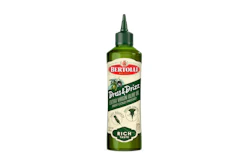
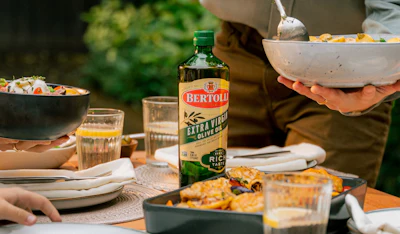
 QR codes on Bertolli and Carapelli bottles connect consumers with product-origin and traceability information, extending what Deoleo can communicate beyond the physical label.Deoleo
Deoleo uses blockchain technology to support that traceability. According to Aparisi, each QR code on individual olive oil bottles is unique and connects consumers with information tied to the product’s varieties and origin. Farmers working with Deoleo provide information that’s uploaded to the cloud and made available through the QR code.
The digital connection also allows Deoleo to update information over time rather than relying solely on a fixed label. For some consumers, Aparisi says, the traceability can make the connection especially personal. “Some consumers can see, ‘This is olive oil from my village,’ or something like that. So the reaction from some consumers is very interesting.”
Engineering models help take material out
While QR codes add a digital layer to the package, Deoleo is also exploring new engineering tools to reduce packaging material without weakening the package. The company is working with a specialized external laboratory in Spain that uses advanced engineering models to analyze the mechanical stresses a container encounters throughout the supply chain. The models can be used to redesign a container and identify opportunities to remove material while maintaining strength, safety, and functionality.
“I believe this technology is the future, maybe enhanced by self-learning AI tools,” Pucci says. “It has significant potential to improve the sustainability of our packaging by reducing material use and environmental impact while maintaining the high standards consumers expect from our products.”
The work fits with the company’s broader primary-plastic reduction program and offers another route to sustainability when changing materials isn’t the most practical answer.
Beyond these engineering tools, Pucci expects recyclable structures, recycled materials, further lightweighting, and connected packaging to continue playing a role. No single packaging solution will be the answer across every application.
“For olive oil, the main challenge will be finding packaging that combines sustainability with the strong protection needed to preserve product quality throughout the entire lifecycle,” he says. “So multilayer, multi-component packaging is the real challenge for the future.” PW