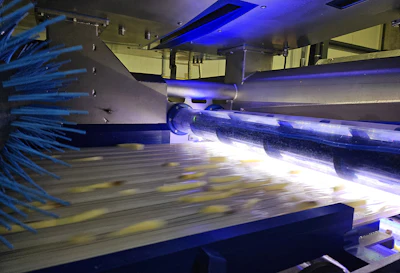
Machine vision systems detect manufacturing defects in real time, preventing costly errors like mismatched product-lid combinations and broken goods from reaching customers. When properly implemented with clear objectives and operator involvement, they reduce waste, compress feedback loops, and transform quality control from reactive discovery to proactive confirmation.
- A chocolate ice cream facility applied vanilla lids to filled cups, requiring an entire shift's production to be scrapped before vision systems were installed
- Vision systems verify multiple variables simultaneously, such as lid graphics against scheduled SKUs and product color consistency, rejecting mismatches immediately
- A confectionery facility reduced consumer complaints about broken bars by installing vision at the cooling-to-packaging transition point, recovering rejected product for reintroduction
- Successful implementations require clear business objectives, intentional engineering of lighting and mounting, operator training, and involvement from plant floor teams
- Real-time defect detection compresses feedback loops, allowing teams to adjust during shifts rather than react at the end, improving overall equipment effectiveness
(Other articles in the Digital Transformation Series: Part 1, Part 3, Part 4)
I worked with a food manufacturer several years ago that experienced an expensive but avoidable mistake. The cups were correct. The fill level was correct. The product quality was correct. But the lids were not.
Chocolate ice cream had been filled into cups, and vanilla lids had been applied on top.
From a distance, everything appeared normal. Containers were sealed and coded properly. Production continued through the shift. But inside those cups was the wrong product for the labeled lid. An entire shift’s worth of production had to be scrapped by the time the error was discovered. The cost extended beyond ingredients: it included labor, lost capacity—and a difficult conversation about how such a mismatch could move through the process undetected.
Situations like this illustrate where machine vision can provide immediate and measurable value.
 Dr. Bryan Griffen is the President of Griffen Executive Solutions LLC. He was previously Senior Director of Industry Services for PMMI: The Association for Packaging and Processing Technologies, and he held a number of roles for Nestlé during his many years there.Griffen Executive Solutions
Vision systems aren’t about adding more screens to the control room. They’re about eliminating preventable risk.
When implemented thoughtfully, they do not add complexity. They reduce uncertainty. They replace assumptions with confirmation and turn delayed discoveries into real-time validation.
Where vision delivers real ROI in processing
Vision systems are often associated with packaging inspection or code verification in food and beverage manufacturing. Those applications are important. However, on the processing side of the plant, the return on investment can be even more direct.
In the ice cream facility mentioned earlier, a vision system was installed directly on the filling line following the mislabeled run. The objective was straightforward: Verify that the correct lid was applied to the correct container and confirm that the filled product visually matched the intended flavor.
The system checked multiple variables simultaneously. It verified lid graphics against the scheduled SKU and analyzed color and texture characteristics of the filled product to confirm consistency with the expected formulation. If a mismatch occurred, the unit was rejected immediately.
The value of the system was not limited to preventing another full-shift scrap event. It changed how the line was operated. Setup errors were identified within seconds rather than hours. QA time spent on post-run verification decreased. Supervisors gained confidence that startup procedures were being validated in real time.
Preventing even a single repeat incident justified the investment. More importantly, the plant shifted from reactive discovery to proactive confirmation.
The shift from hoping errors do not occur to knowing when they do is where vision systems begin to create lasting value.
Preventing waste before it happens
A second example comes from a confectionery facility where the top consumer complaint was broken bars. The product itself met formulation standards. Flavor, texture, and weight were correct. However, fractures occurring late in the process, often during transfer from cooling to packaging, were reaching the customer.
Each broken bar represented more than cosmetic damage. It translated into complaints, potential retailer friction, and diminished brand perception. Internally, it also created tension between processing and packaging teams because the source of the damage wasn’t always clear.
 METTLER TOLEDO’s CV35 combination checkweigher and vision inspection system is part of the company’s mix-and-match portfolio that allows customers to pair a wide range of inspection technologies to meet specific application needs.METTLER TOLEDO
Rejected product wasn’t discarded, it was collected, ground, and reintroduced into the next batch where appropriate. This allowed the facility to recover material that would otherwise have been lost while preventing visibly defective product from ever reaching the consumer.
The impact was measurable. Consumer complaints related to breakage dropped significantly. Scrap was reduced. More importantly, the system provided data. The plant began to see patterns, correlating breakage to upstream handling adjustments, cooling tunnel performance, and even seasonal temperature shifts.
Inspection identified defects, and data helped prevent them.
Done right vs. done poorly
As with any digital technology, machine vision can either solve a problem or create frustration.
In some facilities, vision systems are installed without a clearly defined business objective. Cameras may be mounted where space allows rather than where risk is highest. Lighting is treated as secondary. Tolerances are set too tightly, resulting in excessive false rejects that frustrate operators and erode trust.
In other cases, systems are owned exclusively by QA or engineering, with little involvement from the operators who interact with them every day. When that happens, vision can feel like a policing tool rather than a support mechanism.
Successful implementations tend to begin with a specific, measurable problem. Is the goal to eliminate lid mismatches? Reduce broken product complaints? Verify seal integrity? The criteria for pass and fail are clearly defined and validated under real production conditions.
Lighting, mounting, and environmental factors are engineered intentionally. False reject rates are tested and tuned before full release. Most importantly, operators are trained not only on how to respond to a reject, but on what the system is actually evaluating and why it matters.
When operators understand the logic behind the system, resistance tends to diminish. Vision becomes a tool for maintaining control rather than an interruption.
Real-time insight, not just inspection
One of the most valuable aspects of machine vision is its ability to compress feedback loops.
In traditional inspection models, defects are often discovered through sampling or downstream quality checks. By the time an issue is detected, a significant amount of product may already be affected. Vision systems shorten that gap.
In the ice cream example, mismatches were detected immediately at the point of application. In the confectionery case, fracture patterns could be monitored in real time. Operators were able to observe trends rather than isolated events.
This immediacy changes behavior. Instead of reacting at the end of a shift, teams can adjust during the shift. Instead of debating whether a problem is systemic or isolated, teams can review objective visual data.
For plants tracking overall equipment effectiveness, this has implications as well. The quality component of OEE becomes actionable when defects are identified at the moment they occur. Rather than simply reporting a quality loss after the fact, teams can intervene before that loss compounds.
Vision systems do not replace quality systems. They strengthen them by reducing the time between cause and correction.
Human-centered implementation
It’s important to emphasize that machine vision does not replace people, it complements them.
 P&P Optica's solution automates strip-by-strip inspection and rejection of cooked and raw bacon using real-time measurement, cook-level assessment, and flexible software programs.P&P Optica
At the same time, they free skilled employees to focus on higher-value tasks. QA teams can shift from repetitive visual checks to root cause analysis and process improvement. Operators gain confidence that setup changes are validated immediately, and supervisors benefit from objective data during shift handoffs.
The most successful implementations treat vision as a collaborative tool. Operators are involved early. Thresholds are validated together. Adjustments are made transparently. When the system flags an issue, it is treated as information, not accusation.
That approach often determines whether the technology is embraced or quietly bypassed.
Closing the loop
When thoughtfully implemented, vision systems deliver practical wins on the plant floor. They reduce waste, prevent mislabeling, lower complaint rates, and recover product that would otherwise be lost. They strengthen quality systems by providing immediate confirmation rather than delayed discovery.
More importantly, they change how teams operate. They replace uncertainty with visibility and transform inspection from a reactive safeguard into a proactive control.
In the next article in this series, we will examine how overall equipment effectiveness can move beyond a static scorecard and become an active driver of daily performance.