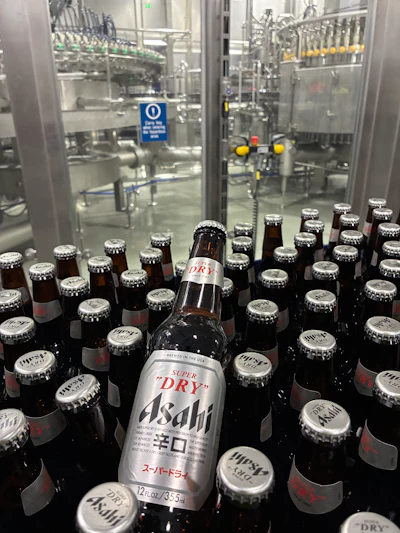
Asahi Group invested $35 million in Octopi Brewing in Wisconsin to establish domestic production of Asahi Super Dry beer, replacing imported bottles from Italy with locally brewed products using advanced high-speed bottling technology.
- Asahi Group acquired Octopi Brewing in Waunakee, Wisconsin and invested $35 million to expand production capabilities.
- The new high-speed bottling line produces 20,000 12-ounce bottles per minute, replacing the previous 7,000 per minute capacity.
- The facility now produces Asahi Super Dry domestically instead of shipping from Italy, reducing ocean freight and ensuring fresher product.
- Wisconsin's central location serves the US market and provides proximity to Canada for expanded distribution.
- The Krones Varioline packer enables multiple packaging configurations on a single platform, supporting diverse retail channel requirements.
Tokyo-based Asahi Group recently acquired Octopi Brewing of Waunakee, Wis.—a contract manufacturer of beer and other beverages since 2014—and is investing $35 million to expand the facility’s capabilities. The move makes it possible to brew and bottle Asahi Super Dry lager in the United States instead of shipping bottles in from a facility in Italy. The significance of this investment is nicely summed up in the marketing message emblazoned on the delivery trucks rolling in and out of the Waunakee plant: “Asahi Super Dry—born in Japan, brewed in Wisconsin.”
A highlight of the investment is a high-speed bottling line. At a time when many beverage producers are consolidating around cans, this investment reflects a deliberate strategy to support continued demand for bottled formats among super-premium, international, and multi-format brands.
And why Wisconsin? “There were a number of factors,” says Juan Morales, plant director at the Waunakee facility. “The location is good not only because is it central to the U.S. market but it’s not far from Canada and we plan to serve that market, too. Plus the brewery had a lot of capabilities, including people, that aligned with what Asahi aims to accomplish.”
“Asahi Super Dry is one of the fastest growing beer brands in the USA across bottles, cans, and kegs,” says Paul Verdu, managing director of Asahi Beer USA. “By investing in a high-speed bottling line alongside our existing canning and kegging capabilities, we are now localizing supply across all core pack formats, reducing reliance on ocean freight, and ensuring the freshest product possible to our customers and consumers.”
In addition to enabling domestic production of Asahi Super Dry, the new bottling line will also allow the Octopi operation to maximize flexibility and fill out their offering to co-packing clients, giving them the ability to meet a broader range of retailer and consumer expectations. In addition to sweeping layers of bottles from full pallets, the depalletizer removes and stacks slip sheets.
Prominent in the new line is equipment from Krones, including the Krones Varioline packer. It makes it possible to run multiple packaging configurations--including multipacks, trays, and wraparound formats--on a single platform. This capability allows Octopi to support a broader mix of co-manufacturing customer requirements without sacrificing efficiency at scale.
“This is about building a platform that can handle complexity,” says Morales. “As brands grow, they need to deliver different formats across different retail channels. This investment allows us to support that evolution with the speed, consistency, and quality required for large-scale distribution.”
The addition of bottling significantly expands Octopi’s ability to support brand partners, particularly those navigating complex retail requirements across grocery, club, and convenience channels.
“As brands grow, they are increasingly looking for production partners that can support multiple formats within a single facility,” said Verdu. “This investment allows us to support both bottled and canned products at scale, while opening the door to new co-manufacturing partnerships that require that level of flexibility.” Rinser, filler, and crowner are all enclosed in a HEPA-filtered room.
90 sea containers
When installation commenced in March of 2026, the equipment arrived in some 90 sea containers. “The installation ran for approximately three months, and then there were more than two months of commissioning,” says packaging project manager Ondřej Štilip. “And before installation could even begin there was all the infrastructure, like new floors with the correct sloping, new drains placed specifically according to exact equipment positions, and proper integration with the municipality. We also had serious space constraints to deal with, which is why we built a big platform above the middle of the bottling line that has most of the electrical and controls cabinets. It was a great way to save space on the actual plant floor. As for the layout itself, it’s a bit atypical in that the packaging equipment isn’t arranged in a straight line or in the shape of a U. It snakes around a bit. But it’s worked out really well.” Bottles in the foreground are just about to enter the pasteurizer while the ones in the background have exited the pasteurizer and are on their way to the labeler.
By September the line was fully up to speed. Offering speeds to 20,000 12-oz bottles/min, it’s a significant boost over the 7,000/min Octopi bottling line it replaced. So far only the 12-oz size has been filled commercially, but 21-oz bottles have been fully commissioned on all machines.
Štilip notes that the controls systems throughout the line are from Siemens. Coming from the Czech Republic as he does, he says he was perfectly comfortable with that technology, since Siemens is widespread on packaging machines throughout Europe. As for the team already in place, it helped that everything about this particular installation, from planning to installation to commissioning, started with a clean slate and involved entirely new packaging equipment. Plus Krones was very helpful in familiarizing the Waunakee workers by way of training where necessary. Eight paperboard carriers at a time are picked from magazine feeds and erected so that they can be picked and placed into corrugated cases that can be seen on the right.
Depalletizing bottles
Bottles are introduced to the line by way of a Krones Pressant Universal sweep-off depalletizer that sweeps layers of bottles onto a conveyor section that single files them so that they can pass through a Krones Linatronic empty bottle inspector. “It’s checking for any cracks, foreign items, residual liquids, or other issues with the glass, especially chips in the neck finish area,” says Štilip. “Should any of these things be detected that bottle is rejected. This ensures that every bottle can be properly closed and sealed.”
Bottles make a 90-deg turn before entering the Krones rinser/filler/crowner monoblock. It consists of a 72-valve rotary Moduljet rinser, a 72-valve Modulfill HES filler, and an 18-station crowner fed by an NSM crown feeder. These are enclosed in a HEPA-filtered clean room that keeps out unwanted air-borne contaminants.
Upon exiting the rinser/filler/crowner, bottles pass through an inspection unit that makes sure fill levels are where they’re supposed to be and crowns are properly seated. Then the bottles enter a Krones Linaflex tunnel pasteurizer where they spend, in the case of Asahi Super Dry, about an hour. Coming out of the pasteurizer the bottles are single-filed so they can pass through a drying unit ahead of the Krones Ergomatic cold-glue labeler. The paper labels are applied to the front, the neck, and the back of each bottle.
Integrated with the labeler is a Videojet ink-jet coder that prints a best-before date on each back label. Then a Krones Checkmat 731 inspection system checks for label presence or skew and an inspection unit from Teledyne TapTone checks for crown tightness.  One of two robotic pickers responsible for picking bottles from a four-lane infeed conveyor and placing them into paperboard carriers that are already inside their corrugated cases
On to the Varioline
At this point the 12-oz bottles, neatly arranged in a mass flow of four lanes, are ready for secondary and tertiary packaging on the Krones Varioline. It consists of three modules, though only two were in operation for the packaging format that was in production on the day Packaging World visited. (Be sure to see the video accompanying this story to fully appreciate the operation of this machinery.)
In Module 2, corrugated cases are picked from magazine feeds and erected. They’re then sent two at a time on a flighted conveyor into a station where each will receive four empty six-pack paperboard carriers. In Module 1, a robotic head picks eight six-pack paperboard carriers at a time from magazine feeds and, through a clever use of vacuum cups, erects all eight carriers. Then a second robotic head picks 48 bottles each cycle and places them in the empty carriers inside the two cases. The filled cases are then carried on a flighted conveyor in the opposite direction from which they entered. When the two cases reach the appropriate spot, they pause and a roboic head closes the open tops of the two cases and glues them shut with an assist from a Nordson adhesive applicator. Robotic tooling that would be used if 21-oz bottles were in production. 12-oz bottles were on the line at the time of PW's visit.
Now the cases make a 90-deg turn and pass through a Mettler Toledo checkweighing unit followed by a Videojet ink-jet coder for lot and date coding of each case. Then the cases make a 180-degree turn and head for the Krones Modulpal PRO palletizer, which is followed by a Lantech SL1500 stretch wrapper.
While six-pack carriers in 24-count corrugated cases is the format that has been in production since the line went into commercial production, other formats are on deck. A 12-count case of 21-oz bottles separated by partitions and no paperboard carriers is one example.  Closed cases pass through a checkweigher and ink-jet coder before making their way to this palletizer.
Now that the new line is up and running, managing director Verdu says he looks forward to adding more shifts than the one currently operating and moving to additional package formats, too. Looking back over the process from planning to capital expenditure approval to commercial operation, he’s pleased at how it’s all gone. “Nothing happens overnight,” he says. “But overall the installation has gone incredibly well, and the line was on time and ready to roll when we needed it. There was an army of people in here with us for several months making sure it all went smoothly, and the whole team deserves a shout out now that it’s been such a success.” PW