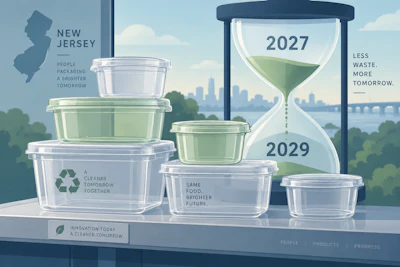
New Jersey's Department of Environmental Protection extended the food-contact packaging exemption under its recycled content law from January 2027 to December 31, 2029, giving manufacturers and brand owners nearly three additional years to implement post-consumer recycled content requirements due to limited food-grade PCR supply and scalability concerns.
- The exemption deadline for food-contact packaging was extended from January 18, 2027 to December 31, 2029, providing manufacturers with three more years to comply.
- The extension does not apply to plastic beverage containers or glass beverage containers, which remain subject to existing PCR thresholds.
- NJDEP cited insufficient food-grade PCR supply and scalability as reasons for the extension, noting the technology has not yet scaled enough for mandatory industrywide requirements.
- Food packaging manufacturers must still register annually with NJDEP and disclose exempt products, though PCR content requirements are deferred.
- Permanent exemptions for milk, dairy products, infant formula, and special dietary foods remain unaffected by the extension.
"For items that already have a plan in place or have transitioned, we will move forward with the change and transition to the new PCR packaging due to our internal circularity ambitions," the source said. "For items that remain challenging, we now have three years to test and incrementally add PCR."
The New Jersey Department of Environmental Protection pushed back the compliance clock for food packaging under the state's landmark Recycled Content Law [called a minimum content law as an industry shorthand], giving CPG manufacturers and brand owners nearly three more years before post-consumer recycled content (PCR) requirements apply to food-contact packaging.
In a memo dated Sept. 2, 2026, NJDEP announced it is extending the law's temporary exemption [click to access memo] for containers and packaging that contain food (originally set to expire Jan. 18, 2027) through Dec. 31, 2029. The extension does not apply to plastic beverage containers or glass containers filled with a beverage, which remain subject to their own PCR thresholds under the law.
One packaging pro at a company that sells packaged food products into retailers in New Jersey told PW that the extension gives manufacturers room to move at different speeds depending on where they stand, even among different products in a wide portfolio.
"For items that already have a plan in place or have transitioned, we will move forward with the change and transition to the new PCR packaging due to our internal circularity ambitions," the source said. "For items that remain challenging, we now have three years to test and incrementally add PCR."
The extension does not apply to plastic beverage containers or glass containers filled with a beverage, which remain subject to their own PCR thresholds under the law.
New Jersey's Recycled Content Law (N.J.S.A. 13:1E-99.135 et seq., P.L. 2021, c.391) took effect Jan. 18, 2022 and requires regulated rigid plastic containers, glass containers, and paper and plastic carryout bags sold in the state to contain minimum percentages of PCR, with thresholds increasing over time. The law built in a five-year exemption for food packaging specifically, while giving NJDEP discretion to extend it.
NJDEP said the extension follows research into the current state of food-grade PCR. The agency concluded that food-safe recycled content technology has not yet scaled enough to support a mandatory, industrywide requirement, that limited supply would leave many food manufacturers unable to comply, and that a large-scale PCR mandate could carry food-quality risk. The agency said it expects food-grade PCR availability to be "more robust" by Jan. 1, 2030, but noted it retains the right to extend the exemption again, or not, as it sees fit.
The scarcity NJDEP points to tracks with what packaging leaders described at the Packaging Recycling Summit in June. There, TerraCycle founder and CEO Tom Szaky argued that recycling only works at scale when the value of the recovered material, plus any subsidy, exceeds the cost of collecting and converting it. That's a dynamic that helps explain why food-grade PCR, which requires extra purification and safety validation before it can touch food, has lagged behind other recycled-content categories even as overall PCR use has grown.
The extension does not change other provisions of the law. Manufacturers of food packaging sold in New Jersey, including retailers with private-label food brands, are still required to register annually with NJDEP and disclose exempt products as part of that process; only the PCR content requirement itself has been deferred. Permanent exemptions for milk and dairy products, infant formula, and food for special dietary use are unaffected.