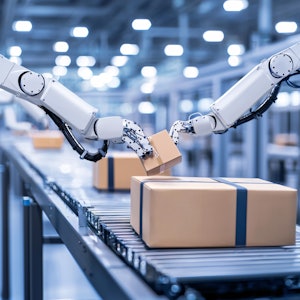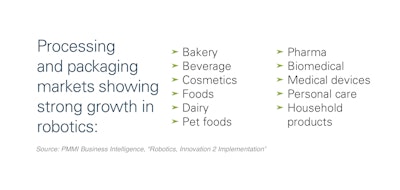
The robotics market is poised for a significant transformation in the near future, growing into new industries and new applications that were once unassailable with robot technology, according to the new study, “2019 Robotics: Innovation 2 Implementation,” a 62-page report just released from PMMI. 2018 represented a major step in expanding the use of general robotics. For the first time, industries like food, consumer packaged goods, and life sciences are expanding robotics applications across their entire production lines in significant numbers.
“Robots are easier to use, with improved sensory functions for autonomous motion and unified control; the costs have declined and in the next ten years the industry is likely to double,” says one Senior General Manager for a robot manufacturer.
“A lack of qualified and available labor in the workforce and the need to increase throughput are the key trends driving the expansion of robotics” says Paula Feldman, PMMI Director of Business Intelligence.
Robot users expect to achieve the following operational improvements:
- Increase speed and throughput
- Reduce labor and labor costs
- Free workers from repetitive tasks to improve worker safety
- Improve product quality
- Flexible manufacturing
There are, however obstacles hampering even faster growth including:
- Cost justification and investment
- Lack of internal expertise
- Finding the right applications
- Time for installation and training
- Overcoming skepticism
“The obstacles we face are based on three components: cost, capital investment, and ROI,” says an Engineering Director in beverage.
“There is an overall lack of internal technical expertise needed to support robotics,” says a Sr. Project Engineer for a major food company.
“We have limited resources and need to identify and prioritize which products or lines are best suited to implement robotics,” added a Manager of Packaging in snacks and bakery.
Download your FREE 9-page Executive Summary below, or PMMI Members can download the entire report for free here.
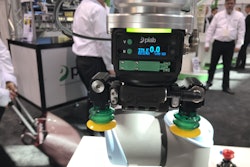
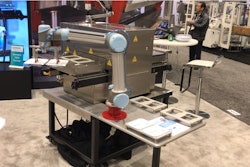
Visit PACK EXPO Las Vegas to see dozens of robots in action, both stand-alone and integrated into packaging machinery.
The robotics market is poised for a significant transformation in the near future, growing into new industries and new applications that were once unassailable with robot technology, according to the new study, “2019 Robotics: Innovation 2 Implementation,” a 62-page report just released from PMMI. 2018 represented a major step in expanding the use of general robotics. For the first time, industries like food, consumer packaged goods, and life sciences are expanding robotics applications across their entire production lines in significant numbers.
“Robots are easier to use, with improved sensory functions for autonomous motion and unified control; the costs have declined and in the next ten years the industry is likely to double,” says one Senior General Manager for a robot manufacturer.
“A lack of qualified and available labor in the workforce and the need to increase throughput are the key trends driving the expansion of robotics” says Paula Feldman, PMMI Director of Business Intelligence.
Robot users expect to achieve the following operational improvements:
- Increase speed and throughput
- Reduce labor and labor costs
- Free workers from repetitive tasks to improve worker safety
- Improve product quality
- Flexible manufacturing
There are, however obstacles hampering even faster growth including:
- Cost justification and investment
- Lack of internal expertise
- Finding the right applications
- Time for installation and training
- Overcoming skepticism
“The obstacles we face are based on three components: cost, capital investment, and ROI,” says an Engineering Director in beverage.
“There is an overall lack of internal technical expertise needed to support robotics,” says a Sr. Project Engineer for a major food company.
“We have limited resources and need to identify and prioritize which products or lines are best suited to implement robotics,” added a Manager of Packaging in snacks and bakery.
Download your FREE 9-page Executive Summary below, or PMMI Members can download the entire report for free here.
Visit PACK EXPO Las Vegas to see dozens of robots in action, both stand-alone and integrated into packaging machinery.
The robotics market is poised for a significant transformation in the near future, growing into new industries and new applications that were once unassailable with robot technology, according to the new study, “2019 Robotics: Innovation 2 Implementation,” a 62-page report just released from PMMI. 2018 represented a major step in expanding the use of general robotics. For the first time, industries like food, consumer packaged goods, and life sciences are expanding robotics applications across their entire production lines in significant numbers.
“Robots are easier to use, with improved sensory functions for autonomous motion and unified control; the costs have declined and in the next ten years the industry is likely to double,” says one Senior General Manager for a robot manufacturer.
“A lack of qualified and available labor in the workforce and the need to increase throughput are the key trends driving the expansion of robotics” says Paula Feldman, PMMI Director of Business Intelligence.
Robot users expect to achieve the following operational improvements:
- Increase speed and throughput
- Reduce labor and labor costs
- Free workers from repetitive tasks to improve worker safety
- Improve product quality
- Flexible manufacturing
There are, however obstacles hampering even faster growth including:
- Cost justification and investment
- Lack of internal expertise
- Finding the right applications
- Time for installation and training
- Overcoming skepticism
“The obstacles we face are based on three components: cost, capital investment, and ROI,” says an Engineering Director in beverage.
“There is an overall lack of internal technical expertise needed to support robotics,” says a Sr. Project Engineer for a major food company.
“We have limited resources and need to identify and prioritize which products or lines are best suited to implement robotics,” added a Manager of Packaging in snacks and bakery.
Download your FREE 9-page Executive Summary below, or PMMI Members can download the entire report for free here.
Visit PACK EXPO Las Vegas to see dozens of robots in action, both stand-alone and integrated into packaging machinery.