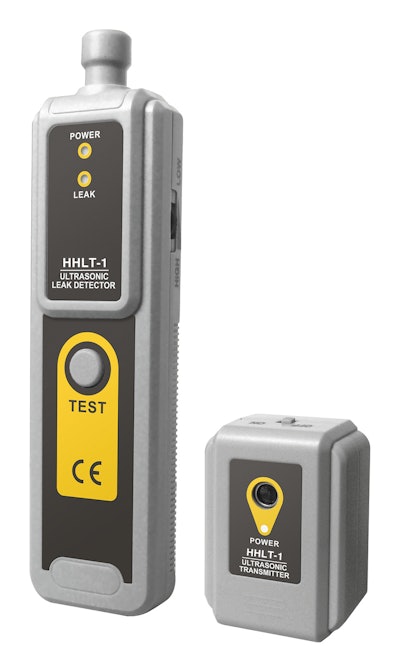
Omega Engineering introduces a new series of CE-compliant ultrasonic leak detectors that feature an ultrasonic sound range of 20 to 100 kHz. The HHLT-1 series is suitable for pressure and vacuum system leak detection, exhaust system, tanks, and pipe leak testing as well as steam trap inspection and gas leaks in general. They are used for chemical processing, refrigeration, vacuum, and steam traps.
Ultrasonic sound (20 to 100 kHz) is generated by turbulence created by air or a gas forced through a small orifice. Ultrasonic sound is very directional in nature and can be used to pinpoint the exact location of the leak point. Leaking air or gas is generally considered to be viscous flow, and as the flow velocity increases, the frequency of the ultrasonic sound emitted will become higher. The HHLT-1R amplifies and converts these sounds to frequencies and levels that the human ear can hear. The HHLT-1T transmitter can supply ultrasonic signals for locations where the gas/air leak does not have sufficient pressure to create an ultrasonic sound. This transmitter will allow the ultrasonic detection of cracks and openings.
When a gas passes through a restricted orifice under pressure, it goes from a pressurized laminar flow to low-pressure turbulent flow. The turbulence generates a broad spectrum of sound called white noise. There are ultrasonic components in this white noise. Since the ultrasound will be loudest by the leak site, the detection of these signals is usually simple.