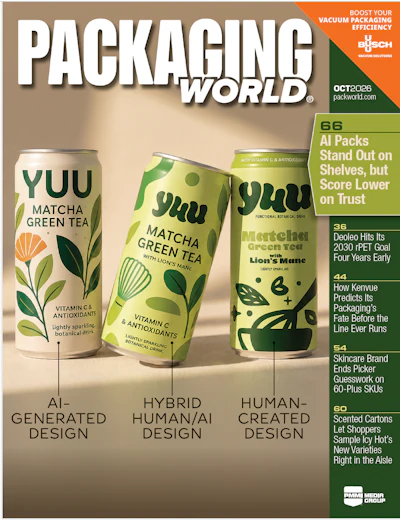
A T&T Design Group study of 3,600 consumers found that packaging graphics created through a hybrid human-AI process significantly outperform both pure AI-generated and human-only designs, earning higher scores for appeal, trust, and purchase intent, with consumers willing to pay 7% more for hybrid designs compared to 1.8% less for AI-only graphics.
- Hybrid designs dominated: Hybrid human-AI graphics scored 5.36 for appeal versus 4.42 for AI-only and 4.85 for human-only on a seven-point scale
- Consumer willingness to pay: Shoppers showed 7% willingness-to-pay premium for hybrid designs, compared to 2.4% for human-only and 1.8% discount for AI-only
- Purchase preference: When choosing which pack to buy, 42% selected hybrid, 39% chose human-only, and only 17% picked AI-only designs
- Trust gap: Hybrid designs achieved 5.08 trust score versus 4.12 for AI-only, suggesting consumers sense quality differences even without knowing design method
- Geographic variation: U.S. respondents were more receptive to AI-only graphics (4.55 appeal) than European consumers (4.28), reflecting different visual culture preferences
Packaging designers have been experimenting with AI-generated graphics, but a new T&T Design Group study suggests shoppers aren’t quite ready to embrace them on their own. While AI-generated package graphics were the most likely to catch a shopper’s eye, the study showed that consumers are not willing to pay as much for products featuring AI-generated graphics as they typically pay for comparable products.
The better-performing approach paired AI with a designer. Across six product categories, graphics developed through a hybrid human-AI process earned the highest scores for appeal, purchase intent, perceived premium quality, trust, and willingness-to-pay. The results show how consumers respond when generative AI moves from creative experimentation into package design.
T&T’s “When Humans Meet Machines” study surveyed 3,600 verified category buyers, divided evenly between the U.S. and five European markets that included Germany, France, Italy, Spain, and the Netherlands. Respondents evaluated front-of-pack graphics for snacks, skincare, functional drinks, vitamins, coffee, and frozen meals.
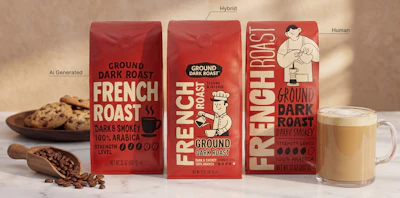
Each person saw three versions of the same product: one designed by a human, one generated by AI, and one created through a hybrid process in which designers refined AI-generated concepts. Product names, variants, and claims remained the same so T&T could isolate the effect of the graphic design.
Consumers give hybrid graphics the edge
The hybrid packs earned an overall appeal score of 5.36 on a seven-point scale, compared with 4.85 for human-only graphics and 4.42 for AI-only. Purchase intent followed the same order, at 3.78 for hybrid, 3.41 for human, and 3.12 for AI on a five-point scale.
The difference became more pronounced when consumers were asked about price. They indicated a willingness to pay 7% above their typical category price for products in the hybrid packs. Human-designed graphics earned a 2.4% premium, while AI-only designs came in 1.8% below the usual category price. When respondents had to choose the pack they would be most likely to buy, 42% selected hybrid, 39% chose human-only, and 17% picked AI-only.
Dr. Steen Tjarks, CEO of T&T Design Group, says the outcome was broadly what he expected. “When it receives a strong brief and good reference material, AI can generate impressive results very quickly,” he says. “However, AI alone still struggles to deliver a fully resolved design through prompting alone. Human creativity, judgment, and craft remain essential for turning an interesting output into a distinctive and commercially effective piece of packaging.”
That need for human judgment extends well beyond cleaning up an AI-generated image. Tjarks says T&T’s work typically starts with people shaping the brief, strategy, references, and creative direction. AI helps expand and accelerate exploration, then designers refine the concept, correct inconsistencies, establish hierarchy, and determine whether the result works for the brand, consumer, and production environment.
Some of that contribution may be difficult to capture in a formal prompt. Tjarks gives the example of a brand manager sharing a single “golden nugget” during a meeting, perhaps a subtle ambition, concern, or insight that never appears in the written brief. Recognizing its importance and translating it into the work, he says, “can be the difference between a concept being rejected and one being selected for rollout.”
AI wins the glance, then gives up ground
On visual standout, AI-only graphics actually beat both alternatives. Their average score of 5.21 narrowly topped hybrid at 5.09 and easily surpassed the 4.32 score for human-only design.
Tjarks attributes some of that advantage to AI’s ability to quickly produce “striking imagery, bold color contrasts, and unexpected visual combinations.” Its first attempts can be considerably more unconventional than the choices a designer might make on their own.
But shoppers didn’t assign the same value to that boldness. Hybrid scored 5.11 for perceived premium quality, followed by human-only at 4.58 and AI-only at 4.33. Trust scores showed an even wider gap. Hybrid reached 5.08 and human-only 4.94, while AI-only fell to 4.12.
Tjarks says a highly novel design can begin to feel “less refined, less credible, or even slightly cartoon-like.” Consumers are also seeing enough AI-generated imagery now that some of its visual characteristics may be becoming familiar, even when they can’t identify the source.
 Functional drinks were among the categories where hybrid graphics showed their strongest advantage, combining AI-driven visual freshness with the clarity and credibility added by human refinement.T&T Design Group
That possibility is especially interesting because participants had no idea how any of the graphics were created. T&T did not identify the designs as human, AI, or hybrid during the research. Still, respondents reacted differently to them.
“Small inconsistencies, overly polished imagery, generic visual choices, or unresolved details can make a design feel less intentional,” says Tjarks. Consumers may not consciously connect those details with AI, he adds, but they can still sense that something isn’t quite right.
The difference was also apparent in how clearly consumers understood the packs. Ninety-two percent correctly identified the product type and variant on the human-designed packs, with hybrid close behind at 89%. Only 77% did so with the AI-only graphics. That suggests AI-only designs may not just feel less credible, they may also communicate the product less effectively.
Tjarks also points to what he calls a “perceived-effort effect.” Consumers may associate the time and craft invested by people with greater authenticity and value, while viewing AI-generated work as faster and less costly to produce. That perception could help explain why consumers were less willing to pay for AI-only designs, even when those graphics were more likely to catch their eye. If brands disclose how a design was created, the effect could put AI-only graphics at an even greater disadvantage, at least in the near term. Tjarks cautions that the effect would need to be tested and could vary by category, market, and consumer group.
Category and market shape the response
Hybrid led across all six categories, but it didn’t win by the same margin everywhere. Its biggest advantage appeared in skincare, functional drinks, and vitamins. Human design came much closer in coffee and frozen meals, particularly on clarity and trust.
Tjarks is careful about attributing those differences solely to the categories themselves. The designers who took part in the study were primarily food-packaging specialists, and they worked within a limited timeframe of roughly one day. That experience may have given the human-only concepts an advantage in coffee and frozen meals.
The other categories presented a different creative challenge. Skincare, functional beverages, and vitamins can demand a mix of efficacy, credibility, modernity, and restraint. Here, AI gave designers another way to quickly push beyond their first ideas and consider a wider range of visual directions.
 Skincare also showed a pronounced hybrid advantage, as packaging graphics in the category must balance modernity and visual appeal with cues of efficacy, trust, and premium quality.T&T Design Group
That makes category a useful consideration rather than a formula. “Brand heritage, audience, emotional sensitivity, regulatory requirements, and the purpose of the project can all change how much AI belongs in the process,” Tjarks explains.
Geography made a difference too. U.S. respondents were more receptive to AI-only graphics than their European counterparts, giving them average appeal scores of 4.55 versus 4.28. Tjarks sees visual culture as one possible explanation, explaining that “the U.S. market tends to be more open to bold, expressive, and visually disruptive packaging”—particularly among challenger brands. The high-impact aesthetic AI commonly produces may therefore look less out of place to U.S. shoppers.
European consumers may read that same treatment differently. Tjarks says they may see it as “excessive or insufficiently nuanced,” a distinction he cautions shouldn’t automatically be interpreted as greater resistance to AI itself.
A promising result, with more to prove
For brand owners, the 7% willingness-to-pay result may be the most commercially intriguing number in the study, but Tjarks cautions against treating it as permission for an automatic 7% price increase.
Instead, he views it as evidence that the hybrid designs created stronger perceived value and potentially more pricing power. At the same time, he says the right AI tools can reduce design costs and timelines by roughly 15% to 20% under the right circumstances, including savings in internal staff time and outside agency spending.
Together, lower development costs and stronger perceived value could benefit brands financially, although the study did not test whether those gains would materialize in the marketplace.
Consumers saw digital front-of-pack images on a neutral background; they did not encounter the packages on a crowded shelf or e-commerce page, and the research did not measure actual sales. Structural design, tactile features, and back-of-pack communication were outside its scope as well.
Tjarks says future testing needs to move closer to real shopping behavior. “The logical next step would be to develop the concepts to a market-ready standard and conduct controlled retail or e-commerce tests,” he says. “Those could measure actual product choice, conversion, price elasticity, and repeat purchase. Survey measures such as stated purchase intent and willingness-to-pay are useful indicators but observed purchasing behavior would provide a much stronger commercial validation.” PW