For a company that is trying desperately to eradicate poor nutrition around the world, automation and analytical insights have meant reaching even more young children in some of the direst situations around the world. “We’re serving the most vulnerable populations, which generally means young children, in the most troubled places in the world. Nutrition relates to about 45 percent of young children’s death. The consequence is dire for the youngest children in particular. It weakens the immune system, it weakens growth,” said Maria Kasparian, executive director of Edesia Nutrition. “There are also economic consequences. When communities are malnourished, it slows the economy.”
Edesia Nutrition is a non-profit manufacturer of ready-to-use therapeutic foods (RUTFs). Just one box of Plumpy’Nut—containing 150 packets of a peanut-based high-energy therapeutic food that treats severe malnutrition—is enough to bring a child from the brink of death to healthy development.
“Poor nutrition is the single most important threat to the world’s health,” Kasparian said. So it’s probably understandable that she also said, “We measure everything in how many children we can reach.”
 Edesia Nutrition’s Maria Kasparian speaks to members of the press at Rockwell Automation’s Perspectives event.Rockwell Automation
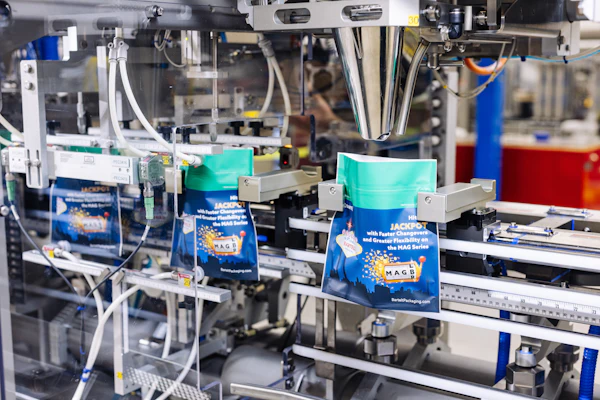
Starting as a small, manual factory in Rhode Island in 2010, Edesia has since grown to a state-of-the-art automated space of 85,000 sq ft, increasing its capacity from 9,000 to 25,000 metric tons. The company went through “huge upgrades” in 2016, Kasparian said, scaling up and also automating, working with system integrator Hallam-ICS to incorporate Rockwell’s PlantPAx distributed control system (DCS) for batch process control.
Edesia’s staff of 105 has also been able to grow their skillsets with the automated operations. Coming from about 25 different countries of origin, Kasparian said, about one-quarter of the staff members are former refugees themselves. “Changing from manual labor to an automated smart factory resulted in workers learning new skills and embracing new technologies,” she said. It was not without effort, however, requiring about six months of just training. “But today, they have higher-skilled jobs, better paying jobs, more satisfying jobs.”
 Adding automation and other upgrades, Edesia has increased capacity from 9,000 to 25,000 metric tons.Edesia Nutrition
The process metrics have allowed employees to make better decisions, Kasparian added, which in turn leads to improved efficiencies. “We’ve had about a 20% increase in our capacity just this year alone,” she said.
In 2019, Edesia surpassed 10 million children—in more than 50 countries—that it’s been able to reach with its products. “Innovations have helped us lower the cost of humanitarian efforts,” Kasparian commented. “That means reaching more children.”