
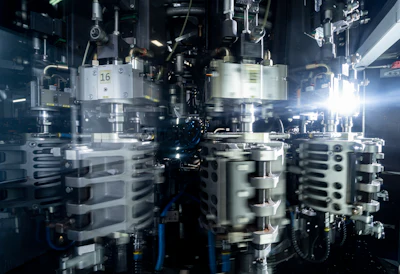
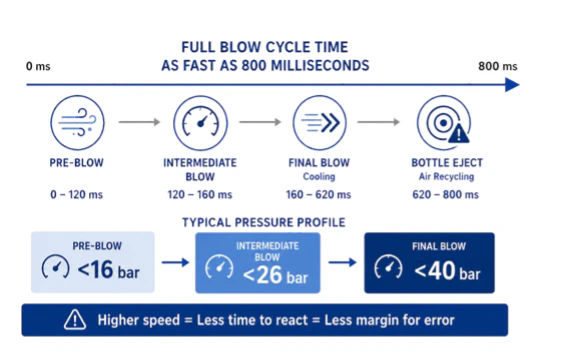
Instabilities in the PET blowing process can significantly impact efficiency for modern bottling operations. As throughput accelerates and next-generation operations target 80,000–90,000 bottles per hour (BPH), the PET blowing sequence compresses into a process window as tight as 0.8 seconds. To put that speed in perspective, that’s less than the duration of a resting heartbeat. It leaves little time to switch valves and maintain pressure. As a result, the process can destabilize quickly without precise, responsive pressure control. When that happens, bottle bursting and deformation become major obstacles to both throughput and efficiency.
Turn process stability into a performance advantage
Over the first 12 months of operation, initial scrap rates of 10-15% are common when PET blow molding processes are unstable. The cost of process instability goes beyond burst bottles — single unstable variable can result in delayed commissioning for OEMs, failed bottle performance tests and bottling line downtime.
But for manufacturers that stabilize the PET stretch blow molding process quickly, the benefits are significant:
- Reduced scrap: A stable blowing process reduces waste and energy consumption while increasing machine utilization and throughput. That means improved efficiency across the line.
- Improved lightweighting: Pressure stability helps operations maintain consistent wall thickness and bottle strength while saving material and supporting lightweighting targets.
- Consistent performance: Stabilization protects wall integrity and dimensional accuracy for uniform performance across every cycle.
- Increased throughput: Precise pressure and timing control stabilize narrow process windows, reducing bottle bursting and production stoppages.
- Adaptable product lines: Dynamic pressure control lets facilities change bottle sizes and formats without compromising pressure stability or product integrity.
Maintain responsive control for every process variable
Achieving stability and realizing those benefits in PET stretch blow molding processes starts with sourcing accurate, responsive technology to control two key variables:
Regulate pressure using dome regulators
Consistent pressure is the foundation on which every stable blowing process is built. Even brief dips or variations in pressure can cause a bottle to deform and burst. When running high cycle rates, each stage of the blow sequence (pre-blow, intermediate, final blow) requires precise and consistent pressure.
As process speed increases, maintaining pressure levels becomes more difficult. Standard switching valves lack the ability to change pressure quickly enough to meet high-speed process windows.
In comparison, advanced dome regulators from Emerson maintain consistent pressure at the blowing station, regardless of throughput rates. They combine a specialized membrane that compensates for pressure deviations and a proportional valve pilot to control chamber pressure. This ensures tight pressure control across all three stages of the blowing sequence. It also adapts seamlessly to format changes, allowing for a more flexible and agile bottling line.Maintain responsive control of flow and pressure with proportional valves
There are three stages to the blowing process: pre-blow, intermediate and final blow. Each individual stage of the blowing process — pre-blow, intermediate and final blow —requires a different level of pressure. Pre-blow stages are approximately 16 bar, while intermediate stages require around 26 bar and final blow stages typically needing around 38-40 bar. With less than a heartbeat for the entire process, moving from stage to stage with precision and accuracy is essential.
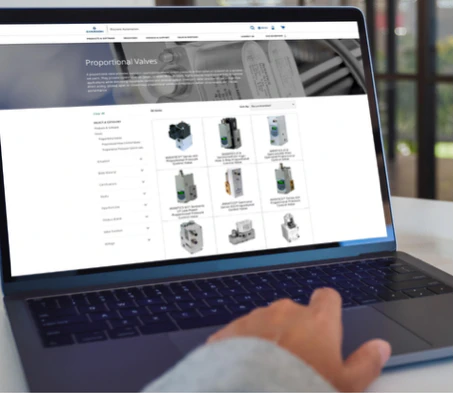
Electronically controlled proportional valves from Emerson helps you calibrate the responsive control these high-speed blowing cycles require. If the integrated or PLC controller detects a pressure change, it automatically adjusts the proportional valve’s opening to maintain stability and ensure a smooth transition to the next stage. In addition to ensuring a consistent, uniform product, this precision flow control also helps protect the system from sudden pressure changes after a bottle burst or other unexpected malfunction.
Pre-engineer your blowing blocks for precision process control
Designing and engineering your own blowing unit from the ground up requires time, resources and pneumatic expertise. To help bridge skills gaps, free up stretched production teams and accelerate equipment development, Emerson partners with OEMs to develop custom blowing blocks tailored to your unique application requirements that can be easily integrated into high-density blowing stations. These compact, pre-engineered solutions help you manage the complete pressure-change sequence with millisecond-level accuracy, creating smooth, repeatable transitions at even the highest cycle rates.
With this approach, OEMs can add optional air recycling capabilities that recover compressed air across the blowing sequence, aseptic designs for hygienic and food-contact applications and PFAS-free innovations to meet evolving material and compliance requirements.
Compressed air recycling
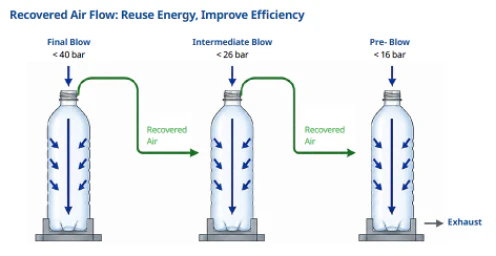
Compressed air is a significant energy cost in PET blow molding. Without an air recovery and recycling mechanism, those compressed air costs are sunk with every cycle. To mitigate these losses, OEMs can combine pre-engineered blowing blocks that integrate air recovery into the blow unit with dome regulators that stabilize pressure fluctuations created by the air recovery process. That allows bottling companies to capture high-pressure air from the intermediate and final blow stages, which can then be used on the next blow sequence, reducing waste without losing pressure stability. Each stage effectively feeds the next, conserving compressed air and energy resources for a more sustainable and cost-effective machine design.
Aseptic applications
For aseptic applications, cleaning is almost as complex as the blowing process. All machine components must be able to handle regular hydrogen peroxide vapor cleaning schedules. Backed by years of field testing material compatibility in aseptic environments, Emerson can help OEMs select durable, chemical-resistant components that offer superior seal performance and design more robust blowing stations.
PFAS requirements
Per- and polyfluroalkyl substances (PFAS) are actively being phased out of consumer products and manufacturing processes worldwide. For bottle-blowing operations, that means transitioning components that come into contact with process air, such as the blowing block, to PFAS-free materials. Emerson helps machine builders tackle this complex design challenge with custom engineering services that support PFAS-free blow molding stations.
Process stability starts with the right partner
Stabilizing high-output PET stretch blow molding processes takes a careful balance of component design, engineering support and process-level partnership. You need someone on your side who understands the demands of the entire process end to end, with the expertise and technology portfolio to help control it.
Emerson engineers collaborate with your team to handle every blow process challenge before it impacts the packaging line. From proportional valve technology and dome regulators to comprehensive blowing block solutions, we combine our innovative product lines with the deep pneumatic expertise to help you achieve process stability faster. Let us help you shorten your time to market and take the risk out of ramp-up.
For more information, visit https://discreteautomation.emerson.com/industries/food-beverage/