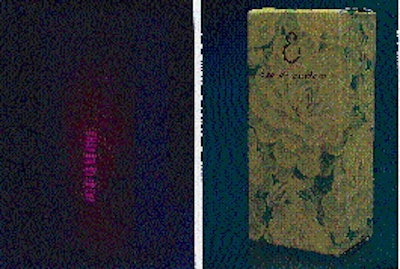
Packaged goods companies like Merck, Revlon and Clorox aren't the only ones in the packaging community using licensing arrangements for technology that was originally developed for internal use. Take Eastman Chemical (Kingsport, TN) for example. About five years ago it developed a novel chemical composition that was colorless, yet could be detected by laser scanners. Eastman's goal was to incorporate the composition in resins of polyethylene terephthalate so that PET bottles could be more readily identified and sorted at recycling centers. While it was successful in developing these chemicals, the PET resin applications never became commercial. Instead Eastman has redeployed them as part of a novel system for printing and scanning invisible bar codes. The patented technology was unveiled at ScanTech and Pack Expo last fall. So far it has not been used commercially. But when it is commercialized, licensing may well be a part of the picture. "A joint venture is one possibility, where two parties bring parts of the technology together," says Eastman new business vice president Gary McGraw. "Or we may license parties to use our technology." The beauty of bar codes that are scannable yet invisible to the naked eye is partially a matter of aesthetics. A code could be printed anywhere on a folding carton, even over the brand's name or logo when space is scarce. Yet it wouldn't detract from the visible graphics. Invisible markers can also be used to docu-ment authenticity of products and/or packaging subject to forgery or unauthorized reproduction. The technology employs inks formulated with compositions based on near-infrared fluorophores (NIRFs). These fluoresce in the near-infrared region of the spectrum, but they're invisible to the naked eye. When laser light from scanners contacts the inks, they produce detectable flourescence, making the bar code scannable. According to Eastman, laser scanning equipment currently used for conventional bar codes can be used to scan these invisible codes as well, though some modifications are necessary to account for differences in wavelength and optics.