Discover What’s Possible in Packaging & Processing, Oct. 18-21 in Chicago
See solutions from 2,600 exhibitors and gain insights from 150+ free educational sessions at North America’s largest packaging & processing event.
REGISTER NOW & SAVE

Pucks combat pack proliferation at Chesebrough-Pond's (sidebar)

A unique twist to handling shingling

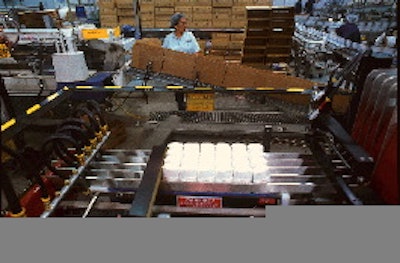
Narrowly spaced lane dividers keep bottles shoulder to shoulder, preventing them from turning, binding or stopping in the case p

When Chesebrough-Pond's upgraded its body wash line, it decided to automate manual case packing. However, the tapered design of several of the containers made them susceptible to shingling that can create feeding problems for automatic case packers. C-P chose a casepacker from Hartness Intl. (Greenville, SC) that's specifically designed to prevent shingling of such containers. At the packer's infeed, a servo-driven diverter directs a single-lane container infeed into four parallel lanes. The diverter, which Hartness refers to as a high-speed laner, uses servo drives to intermittently shift containers into the four lanes. In the four-lane infeed, bottles travel shoulder to shoulder. They are prevented from shingling due to narrowly spaced lane dividers that restrict the bottles from turning, binding or stopping. Bottles accumulate against a backstop until the pack pattern of eight, 12 or 24 bottles is ready. Next, an air transport system grabs the bottles via inflatable air bladders and moves them forward over a grid section. Bottles are dropped about three inches into the grid. The grid lowers until it's positioned over a previously erected case. (Cases are erected and sealed separately.) Once in position, stainless steel fingers on the grid open up and guide the bottles into a tight pattern into the case. In keeping with Chesebrough-Pond's fast-changeover philosophy, the machine requires no tools for changeover, relying instead on handwheels. Changeover takes about 30 minutes for an operator, 15 for a mechanic, and consists of swapping change parts in the diverter, packer bed and laner. An Allen-Bradley (Milwaukee, WI) Model 504 handles many of the changeover settings automatically. "The PLC stores the settings for each particular case that we pack," explains Charles Miller, packaging technology leader. "For each job, there are 36 total parameters that control all pneumatic and timing functions of the machine." Shingling on purpose While the machine worked great for most of C-P's container shapes, some tended to shingle in the boxes during shipping. "That provided an unwanted opportunity to damage the label or the bottles during shipment," says Miller. Ralph Gonzalez, project engineering manager, explains how C-P turned a negative into a positive: "If they're going to shingle, I said why don't we make them shingle all in the same direction?" This notion of controlled shingling in a pack pattern wasn't new to Chesebrough-Pond's. "The concept of purposely shingling in one direction was something we had already accomplished for other applications," says Gonzalez. The concept was, however, new to Hartness. Since the whole design of the machine is geared towards not shingling containers while they're in the machine, the supplier wanted to choose an approach that wouldn't conflict with the existing design concept. The solution was to devise custom grids with contoured stainless steel fingers that forced bottles to twist slightly but uniformly as they dropped into the case, resulting in a tight, shingled pack pattern. (There is a specific grid for each bottle and case count.) Since the shingled bottles take up less room compared to bottles that stand exactly shoulder to shoulder, Chesebrough- Pond's is in the process of shrinking the size of some of its cases. That will mean more cases on a pallet. Additionally, once the company switches over to the new shingled case pack format, it will eliminate the use of corrugated dividers currently used for topload strength and bottle protection. "Not only is it a cost savings," says Miller, "but the bottles are able to handle that load."

Videos from ITW Hartness
Laner
Elevator
Need help with your packaging project?
We’ve done the legwork to identify and vet experienced packaging and processing consultants you can contact directly for your next project. Decades of combined experience in packaging line engineering, machinery selection, package and materials development, and food processing operations.
See your advisor options now.
Need help with your packaging project?
Is your packaging line built for connected packaging?
RFID, QR codes, and 2D barcodes are reshaping CPG operations. See how leading brands are adapting.
Read More
Is your packaging line built for connected packaging?