Discover What’s Possible in Packaging & Processing, Oct. 18-21 in Chicago
See solutions from 2,600 exhibitors and gain insights from 150+ free educational sessions at North America’s largest packaging & processing event.
REGISTER NOW & SAVE

Barber Foods pops for an alternative

When stretch wrap's true colors showed through-and weren't green-this chicken product producer switched to an adhesive palletizing system.

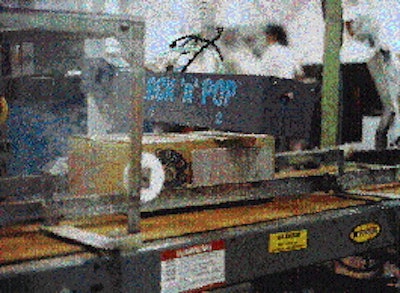
At the end of Barber Foods? packaging line, Lock?n?Pop is applied to a box top by two pneumatically operated nozzles

Barber Foods, a Portland, ME-based producer of chicken products including boneless stuffed breasts, stretch wrapped its pallet loads for years with minimal problems. But as environmental consciousness came to the fore, stretch wrap disposal became an issue. "We had customers threaten that they might not buy our product unless we stopped using stretch wrap," says Bill Whittier, production manager of Barber Foods. Some customers, says Whittier, wanted to charge Barber $5 per pallet to cover their disposal costs. The company sells to foodservice, retail, convenience store and warehouse club channels throughout North America and exports to companies as far away as Russia. Yet another customer told Barber about the Lock'n'Pop system from Key Tech (Mukilteo, WA). In 1992 the system was installed. Two pneumatically-operated nozzles mounted near the end of a packaging line spray measured amounts of the liquid onto case tops. After taping and ink-jet coding, hand-packed cases pass a photo-eye that triggers application of Lock'n'Pop onto the top of the carton. Boxes are then removed from the conveyor manually and stacked on a pallet to a designated height. When the shipment reaches the retail or foodservice outlet, cases are easily unstacked or "popped" apart thanks to the low tensile strength of the adhesive. The product also leaves the printing intact. "All of our cases are preprinted with a pledge from founder Gus Barber," says Whittier. "We were very concerned that the adhesive wouldn't damage the printing. We did a lot of testing before we purchased the system." The customer is always right "There's no difference in performance between the two," says Whittier. "The only drawback is that the person stacking the cartons has to remember to turn the glue off before he gets to the top layer so that the top of the pallet stays clean. But in a ten-high stack of cases, that also saves us 10% of the glue costs." Unforeseen benefits come in the form of savings: the new system has reduced Barber's pallet unitizing costs by 32% and has saved a minimum of 1.5 hr/day in labor time. "It's doing as good a job as stretch wrap did," Whittier goes on, "it's just the green issue. You might say we're able to sleep a little better at night."

Is your packaging line built for connected packaging?
RFID, QR codes, and 2D barcodes are reshaping CPG operations. See how leading brands are adapting.
Read More
Is your packaging line built for connected packaging?
Discover How to Stay Ahead of the Competition at PACK EXPO International
See new solutions from 2,600 exhibitors. Gain insights from 150+ free educational sessions. From automation & robotics to real-time data insights, find the tech for your company’s future at North America’s largest packaging & processing event.
REGISTER NOW & SAVE
Discover How to Stay Ahead of the Competition at PACK EXPO International